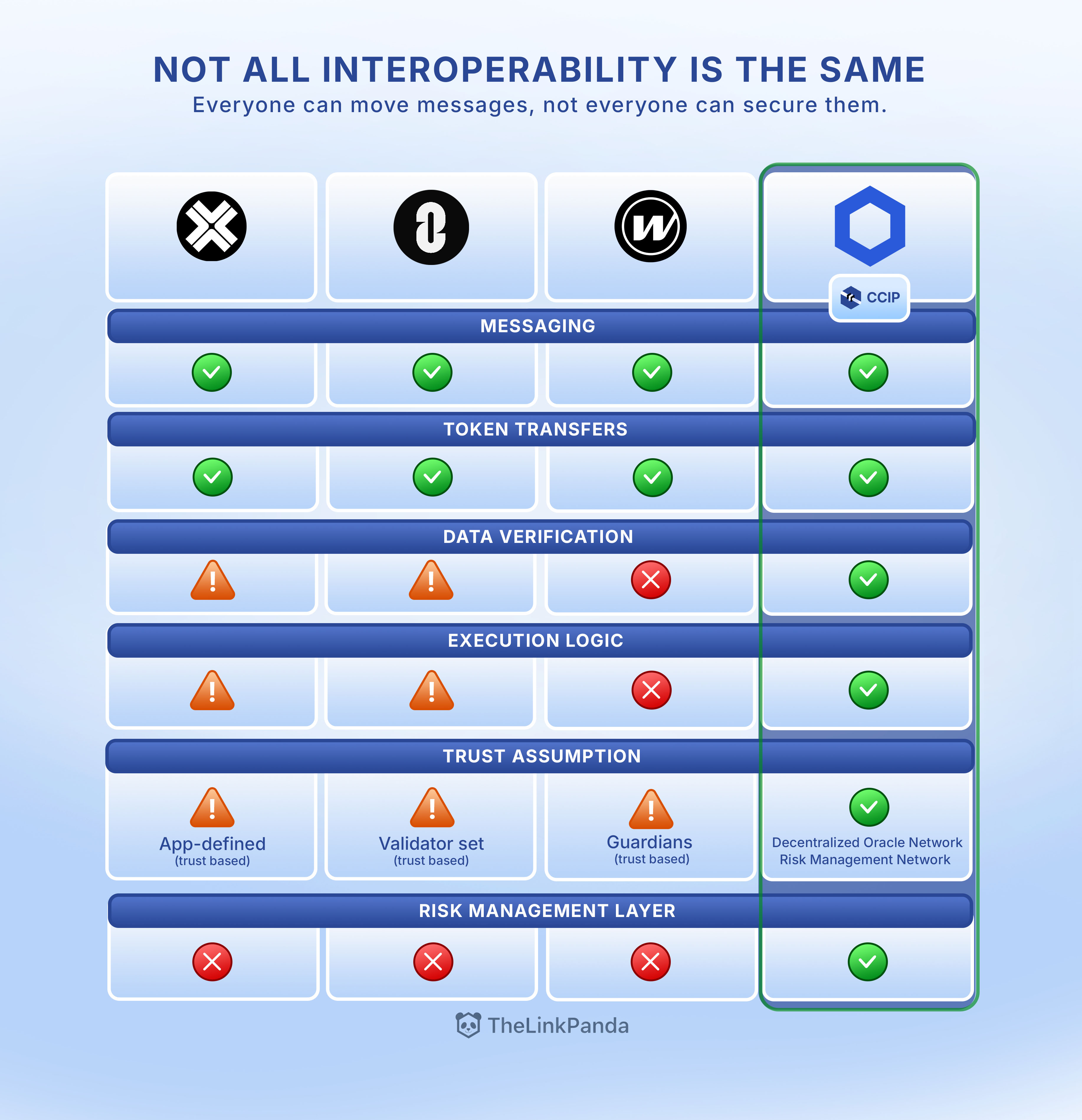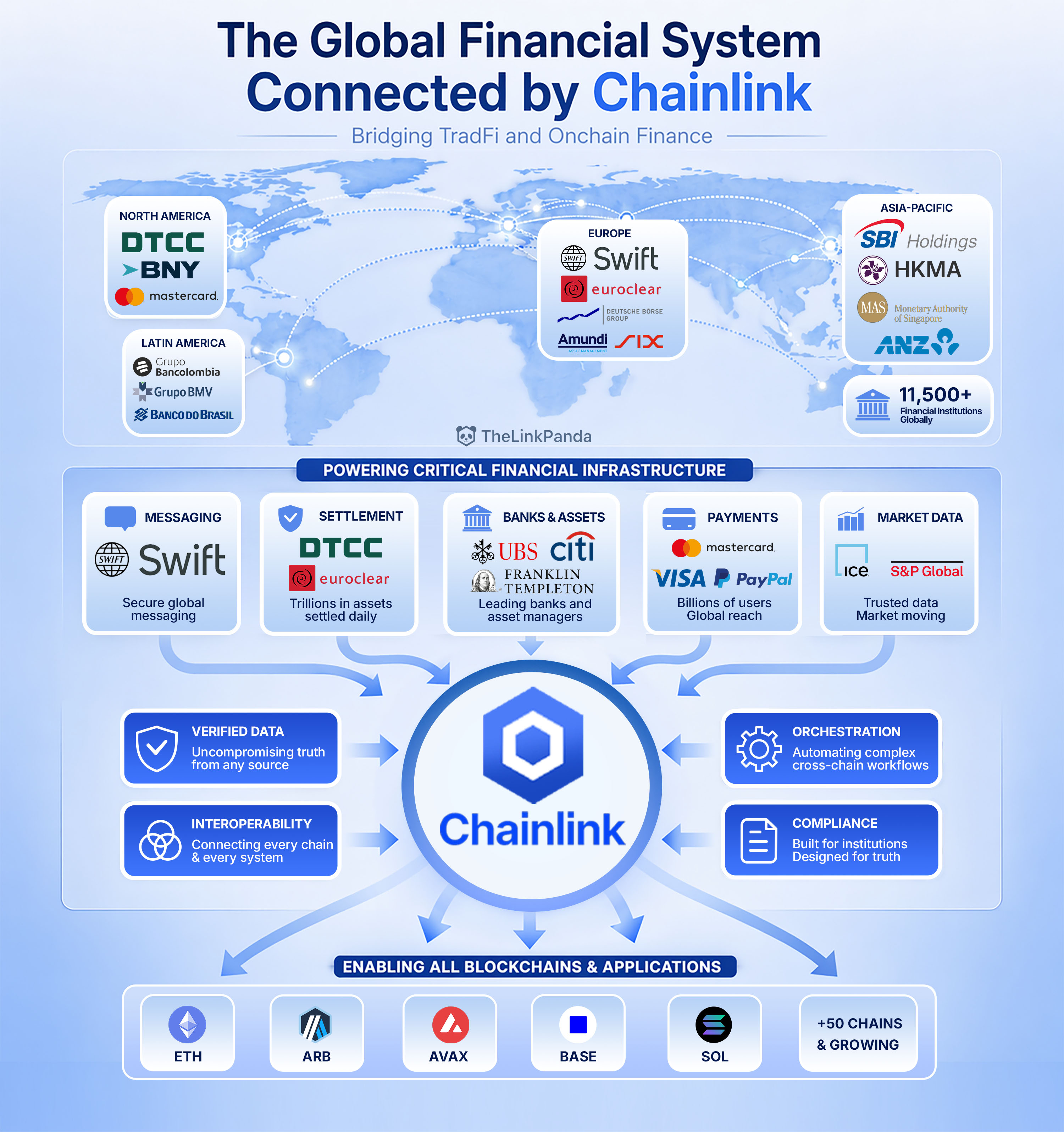



The internet's most comprehensive evidence library connecting patents to Chainlink infrastructure — direct Chainlink patents, patents naming Chainlink, patents citing Chainlink as prior art, and patents whose claimed infrastructure aligns with Chainlink services. Sourced from USPTO and Google Patents.
Short-form visual explainers on digital finance infrastructure. Each Short is designed to stand alone as a clear, researched answer to one infrastructure question.
An entry enters the Evidence Vault only if a primary or first-party source documents it: an official press release, a regulator or central-bank publication, a company statement, a filing, a patent record, or direct reporting that names the parties involved. Aggregator articles and social-media claims are not sufficient on their own — they may point us toward a story, but the entry cites the underlying source.
Where a claim comes from one party about another (for example, a vendor describing its role in a client's project), the entry says so explicitly rather than blending the two into a single assertion.
Not all adoption is equal, and conflating a conference appearance with a live deployment is how research loses credibility. Every entry is graded into one of four classes, stated in the entry body:
Live systems handling real assets, real money, or real transactions. Highest bar.
Formal experiments, proofs-of-concept, or limited-production phases inside an official programme. Real work, not yet live at scale.
Formal relationships without deployment: signed MoUs, official programme selection, invited participation, conference panels.
An institution describing or analysing the technology in its own publications — explicitly not an endorsement or an adoption.
If an institution appears on the Adoption World Map, the colour reflects its strongest verified class — and each listed connection carries its own class label, so a country with one production system and one research mention is not presented as uniformly "adopted."
The percentage on each entry describes source strength and verifiability — not the importance of the news, and not a prediction about anything.
Where an entry's confidence is capped by a specific limitation (for example, a company's claim about a partner's project), that limitation is written into the entry's context field rather than hidden in the number.
Entries use the language of the source, not promotional language. If a report says a system "was due to come on stream in November 2025," the entry says that — it does not say the system is live. If a programme is a simulation with no real funds, the entry says so. Overstating deployment is the single most common failure in crypto research, and avoiding it is the point of this site.
Documented adjacency is not participation. If an institution works with Chainlink on one initiative and separately participates in an unrelated programme, those are recorded as two separate facts — never merged into a claim that Chainlink is "in" the second programme. Analysis that draws connections between separate facts is published in the Research Digest and labelled as analysis, not as evidence.
Nothing on this site is investment advice, a price prediction, or a recommendation to buy or sell anything.
Errors get fixed, visibly. If an entry is wrong, it is corrected or removed — not quietly softened. If you can show that something here is inaccurate, or you have a primary source for a connection that is missing, please send it: corrections are welcomed and acted on, and the correction matters more than being right the first time.
TheLinkPanda is an independent research project. It is not affiliated with, funded by, or endorsed by Chainlink Labs, the Chainlink Foundation, or any institution documented on this site. No payment is accepted in exchange for adding, removing, or changing an evidence entry.
As with most independent researchers covering a single ecosystem, the author holds a position in the asset discussed. That is a real conflict of interest, and it is disclosed here so readers can weigh the research accordingly — which is also why every claim is built to be checked against its original source rather than taken on trust.
Figures on the Live Metrics page come from third-party providers and official sources, each linked on the metric itself. Values are labelled by type: live (fetched from an API at page load), verified (manually checked against a named source on the date shown), and estimate (derived or approximate, with the basis stated). Where a live feed is unavailable, the last verified value is shown with its date rather than a stale number presented as current.
LINK has three distinct functions inside the network. Conflating them is the source of most confusion:
Users of Chainlink services — data feeds, CCIP messages, automation, compute — pay fees, and node operators are compensated in LINK. This is the original and simplest function: LINK is the unit of account for oracle work.
Node operators lock LINK as a bond backing their promise to report honestly and reliably. If they misbehave or fail to perform, that stake can be slashed. The stake is not a yield product — it is economic skin in the game that makes dishonesty expensive.
The value of staked LINK determines the cost of attacking or corrupting a . Systems securing large amounts of value need a proportionally meaningful security budget — that relationship is the core of the design.
Related misconception corrections:
Chainlink is frequently described as "just price feeds." In practice the network operates several distinct fee-generating services. Each is a real product with real users; their relative size varies, and Chainlink does not publish a full audited revenue breakdown, so treat any precise revenue figure you see — anywhere — with appropriate caution.
Each service links to its own page — what it does, who uses it, and the evidence. Also see:
This is the mechanism that connects network usage to the token, and it is the part most often missed. It works in two steps.
Step one — . Users do not have to hold LINK to pay for Chainlink services. They can pay in gas tokens, stablecoins, or (for enterprises) offchain in ordinary fiat invoices. Those payments are then programmatically converted into LINK onchain, using Chainlink services and decentralized exchange infrastructure. The friction of "you must acquire our token to use our product" is removed for the customer, while the fees still end up denominated in LINK.
Step two — the . Launched on 7 August 2025, the Reserve is an onchain reserve that accumulates the LINK produced by that conversion process. It is funded from both onchain service fees and offchain enterprise revenue. Chainlink states that no withdrawals are expected for multiple years, so accumulated LINK is effectively locked away as it builds.
The split is not a single fixed ratio across all services — it varies by service and by whether that service is secured by staking. The clearest published example is SVR: recaptured MEV is first split between the application and the Chainlink Network (Aave’s launch terms were 65% Aave / 35% Chainlink), and the Chainlink portion is then directed onward. Chainlink states that 50% of fees from staking-secured SVR services — originally earmarked to cover node operator rewards — is now planned to help fund the Reserve, with the remainder going to node operators and community stakers.
Why this matters structurally: rewards funded by fees behave very differently from rewards funded by new issuance. One depends on customers using the product; the other dilutes existing holders. This design is an explicit attempt to shift from the second to the first.
The Reserve publishes its holdings onchain with a public dashboard at reserve.chain.link and metrics.chain.link/reserve. Rather than reproduce a figure here that will be stale within days, check it directly — that is the whole point of an onchain reserve. Reported accumulation has grown from roughly 70,000 LINK at launch to weekly inflows in the six figures during 2026.
Staking in Chainlink is not the same as staking on a proof-of-stake blockchain. There are no blocks being produced and no transactions being ordered. Instead:
The economically important idea is alignment: the party providing the data has money at risk if the data is wrong. That is what a bond does, and it is why staking is a security mechanism first and a reward mechanism second.
Staking rewards have historically been funded substantially by protocol emissions from reserves rather than purely by service fees. This is a real dilution consideration and it deserves to be stated plainly rather than waved away.
The stated design direction is that as network usage grows, fee revenue becomes a larger share of what funds rewards, and emissions a smaller one. Payment Abstraction and the Chainlink Reserve are the infrastructure built for that transition, converting real customer payments into LINK rather than minting it. Programs like BUILD add further non-dilutive flows — value arriving from partner protocols rather than from new issuance.
Whether fee revenue grows fast enough to meaningfully replace emissions is an outcome that depends on future adoption — it has not happened yet and cannot be asserted as fact. Anyone claiming certainty in either direction is speculating. What can be verified today is the direction of institutional adoption, which is what the evidence vault documents.
The tokenomics only function at scale if the services are actually used at scale. That is why this site spends its effort documenting verified institutional adoption rather than modelling prices: adoption is the input, and it is observable. Everything downstream of it is inference.
Whether a central bank runs a settlement pilot, whether a market infrastructure moves from proof-of-concept to production, whether a bank uses CCIP for real transfers — these are checkable facts, and they are the honest place to focus.
No price targets. No supply-and-demand models projecting a value. No "if X% of the market adopts, then LINK is worth Y" arithmetic. Those calculations are trivial to construct and consistently wrong, and publishing them would undermine the point of a research vault.
Nothing on this page is investment advice. Read the for how this site handles evidence, uncertainty, and conflicts of interest.
High-signal statements from executives, institutions, and researchers on Chainlink, digital finance infrastructure, tokenisation, and the architecture of the emerging financial system.
New evidence, institutional announcements, infographics, and analysis are published daily.
Follow @TheLinkPanda on X →Submit evidence, quotes, sources, timestamps, or misconceptions that can improve the Chainlink research archive.
Accepted contributions may be credited using your chosen display name.
All submissions are reviewed before publication. No accounts required.
Accepted contributors are credited by display name. Contributor badges coming in a future update.
What DTCC, SWIFT, JPMorgan, Euroclear, and 50 more institutions reveal when you read all the evidence together.
Read the Research →TheLinkPanda ("we", "this site") is an independent research platform operated from Belgium. This page explains what data is collected when you visit thelinkpanda.com, why, and how you can contact us about it.
This site uses Cloudflare Web Analytics, a privacy-friendly analytics service that does not use cookies or collect personal data, and does not track you across other websites. It provides us with aggregate information such as page views and approximate visitor counts.
If you use the contact form on the Work With Me page, we collect the name, email address, and message you provide, solely to respond to your enquiry. This information is not shared with third parties and is not used for marketing without your consent.
Some pages may embed content from third-party platforms such as YouTube, X (Twitter), TikTok, or Instagram. These platforms may set their own cookies or collect data according to their own privacy policies when you interact with embedded content.
This site does not use tracking cookies, advertising cookies, or cross-site tracking technology. Cloudflare Web Analytics operates without cookies.
Under the GDPR, you have the right to access, correct, or request deletion of any personal data we hold about you (for example, information submitted via the contact form). To exercise these rights, contact us using the details below.
For privacy-related questions or requests, contact: [email protected]
By accessing TheLinkPanda (thelinkpanda.com), you agree to the following terms.
All content on this site — including the Evidence Vault, Infrastructure Explorer, Misconceptions library, Quote Library, articles, and visualisations — is provided as-is, for educational and informational purposes. While every effort is made to verify sources and cite them accurately, we make no guarantees of completeness, accuracy, or that information remains current after publication.
TheLinkPanda is an independent research project and is not affiliated with, endorsed by, or operated on behalf of Chainlink Labs, SmartContract Chainlink Ltd, or any institution referenced on this site (including but not limited to DTCC, Swift, JPMorgan, Circle, Coinbase, Euroclear, and others). Institution names, logos, and quotes are used for identification and commentary purposes under fair use.
This site links to external sources, press releases, and third-party websites for citation purposes. We are not responsible for the content, accuracy, or availability of external sites, which belong to their respective owners.
Nothing on this site constitutes financial, investment, legal, or tax advice. See our Disclaimer for further detail.
These terms may be updated from time to time. Continued use of the site after changes constitutes acceptance of the revised terms.
Questions about these terms: [email protected]
The information on this website is provided for educational and informational purposes only and should not be considered investment, legal, or financial advice.
TheLinkPanda discusses topics including cryptocurrency, blockchain infrastructure, tokenization, and institutional finance. Nothing published here — including the Evidence Vault, Live Metrics, Misconceptions library, Network Calculator, or any commentary — should be interpreted as a recommendation to buy, sell, or hold any asset, token, or security. Cryptocurrency markets are highly volatile and carry significant risk of loss.
TheLinkPanda is an independent research project. We are not a licensed financial advisor, broker-dealer, or investment professional. Always conduct your own research and consult a qualified, licensed professional before making financial decisions.
We aim to cite verified, primary sources for all evidence presented on this site, with direct links where possible. However, information about live metrics, institutional partnerships, and announcements may change after publication. We do not guarantee that any figure, quote, or status shown on this site remains accurate at the time of your visit. Always refer to the linked primary source for the most current information.
TheLinkPanda and its operator accept no liability for any loss or damage arising from reliance on information published on this site.
Questions about this disclaimer: [email protected]